
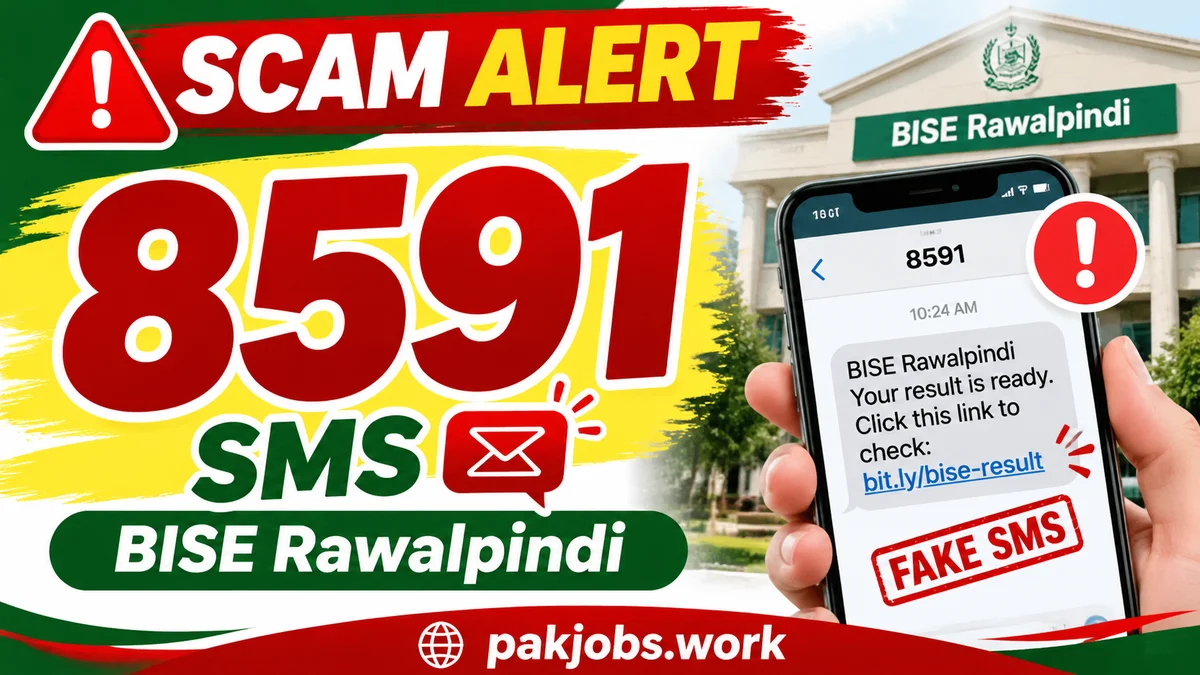
Students of the Board of Intermediate and Secondary Education Rawalpindi are receiving the same worrying message. It names the student, says a fee is due for the SSC 2nd Annual Examination 2026, gives a long payment number called a PSID, and warns the result will be withheld unless the fee is paid. It looks official because it uses the student's real name and the board's name. It is not from the board. This page explains how to tell it is fake and what to do next.
Key Takeaways
- Do not pay any fee demanded by an SMS from 8591. It is not from BISE Rawalpindi.
- The SMS code reported for the board's 2026 result service is 800296. The number 8591 is the SMS short code of TCS, confirmed by TCS's own scam alert post of 4 June 2025.
- The board never asks for payment by SMS. A real PSID is created only after you fill a form on the board's e-services portal.
- The SSC 2nd Annual 2026 result date has not been announced yet, so a message that threatens to withhold your result is running ahead of the board.
What the Fake Message Says
The message follows one fixed pattern. It starts with DEAR and the student's name, says SSC 2nd Annual 2026, names a fee, gives a PSID, and ends with the warning that the result will be withheld unless the fee is paid. It signs off with BISE RWP. Two amounts have been seen, Rs 100 and Rs 1,000, for the same examination.
It arrives from the short code 8591. It feels genuine because it names the student, but student names and examination sessions appear in admission lists and school records that pass through many hands. The threat creates fear: a student waiting for the result pays at once, without checking. A real fee notice does not arrive as a threatening text message.
Why 8591 Is Not the Board's Number
The first check is the number itself. The SMS code reported for BISE Rawalpindi's 2026 result service is 800296. Several result guides published for the 2026 results list this code: type only your roll number and send it to 800296. The Punjab boards use 80029x codes, so Rawalpindi's 800296 fits the pattern. Confirm it on the board's website first.
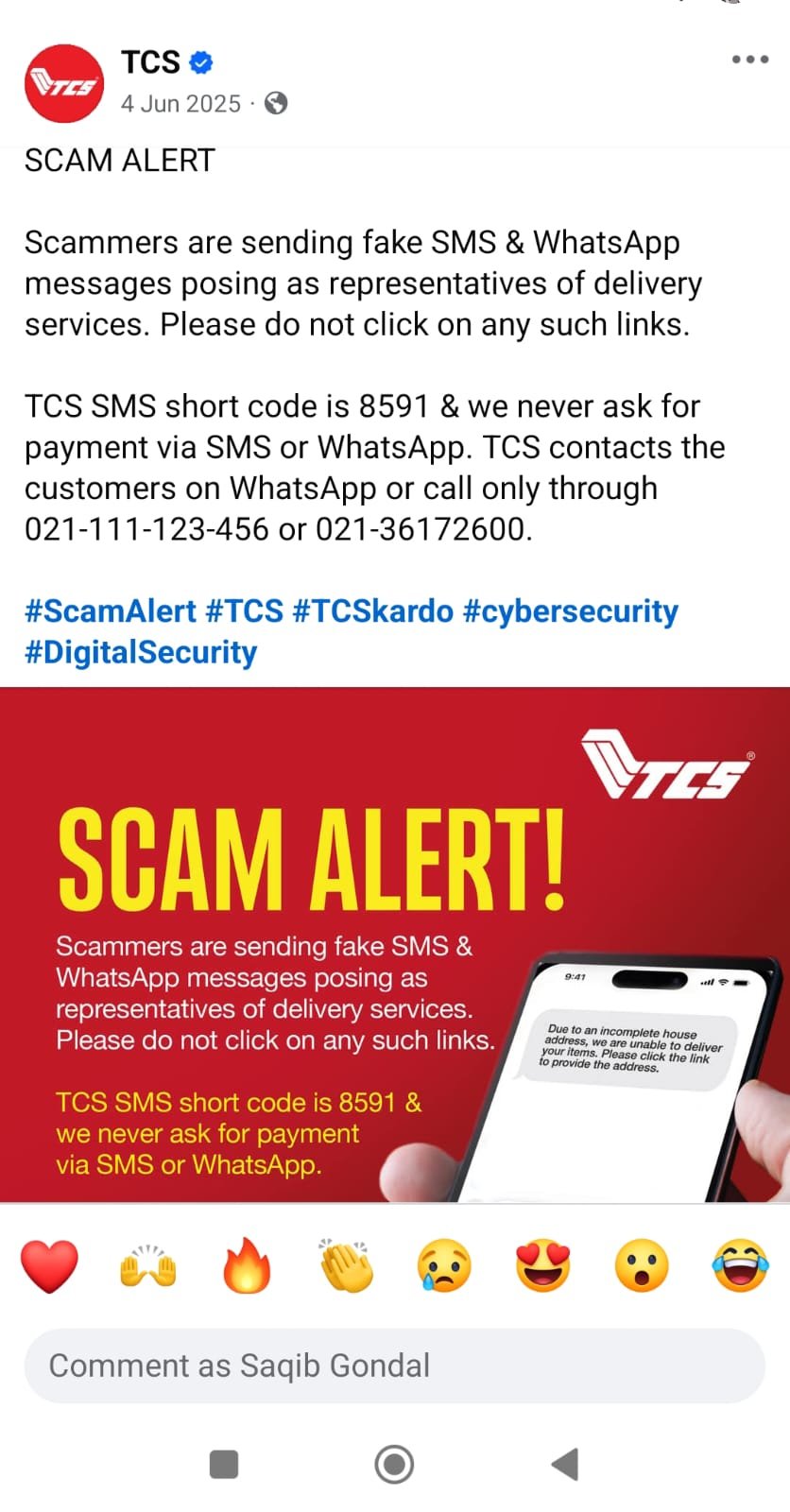
The number 8591 belongs to TCS, the courier company. TCS said so in a scam alert post on its verified Facebook page on 4 June 2025: "TCS SMS short code is 8591 & we never ask for payment via SMS or WhatsApp." The post also warns: "Scammers are sending fake SMS & WhatsApp messages posing as representatives of delivery services. Please do not click on any such links." The post is about fake delivery messages, not the board, but it settles who owns 8591: TCS, not BISE Rawalpindi.
A message from 8591 claiming to be from the board is therefore using a courier company's number. That alone is enough to treat it as fake. A sender number can also be faked, so the number is only the first check. The second check is what the message asks you to do.
How a Real Board Message and a Real PSID Work
Checking your result costs nothing. When the board announces the result, open the official portal at results.biserawalpindi.edu.pk, select your class and session, and enter your roll number. The board also publishes a result gazette. No payment, no CNIC and no password is needed to see your result.
A PSID is real, but it does not work the way the fake message describes. A PSID is a 19-digit Payment Slip ID used for the board's online services, for services such as verification or rechecking. A real PSID is created only after you fill a form on the board's e-services portal at eservices.biserawalpindi.edu.pk. You then pay through EasyPaisa, JazzCash, 1Bill or online banking, and receive a tracking ID. The board does not send a PSID by SMS and demand payment.
No board service asks for payment through a link or number in a text message. If a message asks for money, your CNIC, an OTP or a photo of your roll number slip, it is not the board. The board's official website is biserawalpindi.edu.pk, and anything that matters will be published there first.
The "Result Withheld" Threat Does Not Add Up
The SSC 2nd Annual 2026 examinations started on 6 October 2026, and the practical examinations ended on 17 November 2026. Marking and compilation are now under way. As of 20 November 2026, no Punjab board had issued a result-date notice. The date 8 December 2026 is only the tentative listing in the Punjab Boards Committee of Chairmen schedule from March 2026, and it can change. A message that threatens to withhold a result that has not even been announced yet is running ahead of the board.
The two different amounts are another sign that the numbers are made up. A real board fee is the same for every student in the same category, but these messages demand Rs 100 from one student and Rs 1,000 from another for the same examination. A genuine fee notice would come through the school or the board's portal, with a proper challan. The board has published no notice about these messages, so tell your school.
What to Do If You Got the Message
Do not pay the PSID, do not click any link in the message, and do not reply with your CNIC, a photo of your roll number slip or any OTP. Delete the message after reporting it, and check your result only on the official portal when the board announces the date. Tell your school and parents the same day.
If you already paid, act at once. Call your bank or mobile wallet helpline and ask them to block or reverse the payment. Keep the SMS and the payment receipt as your proof. Then report the fraud to the National Cyber Crime Investigation Agency on helpline 1799 or at complaint.nccia.gov.pk, and forward the message to PTA at 9000.
How to Report the Message
Report the message to PTA, the telecom regulator. Forward it to short code 9000: type the sender's number, leave a space, paste the message text, and send it to 9000. PTA acts on the sending number. You can also complain on PTA's portal or call the toll-free helpline 0800-55055.
For fraud, report to the National Cyber Crime Investigation Agency, or NCCIA. The NCCIA replaced the FIA Cyber Crime Wing in 2025 and handles all cybercrime complaints in Pakistan. Call its 24-hour helpline 1799 or file a complaint at complaint.nccia.gov.pk. Older guides still list the FIA helpline 1991, but that number is outdated, so use 1799 instead.
Related on Pak Jobs
- Latest results and merit lists
- Latest government jobs in Pakistan
- BISP Dynamic Survey Registration 2026
Frequently Asked Questions
Is the SMS from 8591 about a BISE Rawalpindi fee real?
No. The SMS code reported for the Rawalpindi board's 2026 result service is 800296, not 8591. The number 8591 is the SMS short code of TCS, confirmed in TCS's scam alert post of 4 June 2025. The board never asks for payment by SMS, so a message demanding a fee is fake.
What should I do if I already paid the PSID in the message?
Call your bank or wallet helpline at once and ask them to block or reverse the payment. Keep the SMS and the payment receipt as proof. Then report the fraud to the NCCIA helpline 1799 or at complaint.nccia.gov.pk, forward the message to PTA at 9000, and tell your school so other students are warned.
How do I check my real SSC 2nd Annual 2026 result?
Use only the board's official result portal, results.biserawalpindi.edu.pk. Select your class and session, enter your roll number, and the result will appear. The result date has not been announced yet. 8 December 2026 is only the tentative listing in the PBCC schedule, so confirm the date on the board's website before you check.
How does a real PSID from the board work?
A real PSID is a 19-digit Payment Slip ID created only after you fill a form on the board's e-services portal, eservices.biserawalpindi.edu.pk, for a service such as verification, migration or rechecking. You then pay through EasyPaisa, JazzCash, 1Bill or online banking and get a tracking ID. The board never sends one by SMS.
How do I report the fake SMS?
Forward the message to PTA at 9000: type the sender's number, leave a space, paste the message text, and send it. For fraud, report to the National Cyber Crime Investigation Agency on its 24-hour helpline 1799 or at complaint.nccia.gov.pk. Also tell your school and parents, so the warning reaches other students quickly.